An AI service needs an identity, a registered provider and a way to inspect what happened after execution. PACT brings discovery, a job lifecycle and payment verification into one product, so the evidence can be examined alongside the service.
Project 05 / PACT
If an AI service is paid for work, the work should be independently verifiable.
The project
A settlement layer connecting AI service discovery, inference attestation, payment and portable agent reputation on 0G.
The product problem
Discovery does not tell a buyer whether to pay.
Our conviction
Make the proof part of the transaction.
A buyer funds a job for a registered service. The seller executes inference and submits the provider attestation. Verification checks the recovered signer against the service’s registered signing address before settlement.
The product surface
From a service to a traceable job.
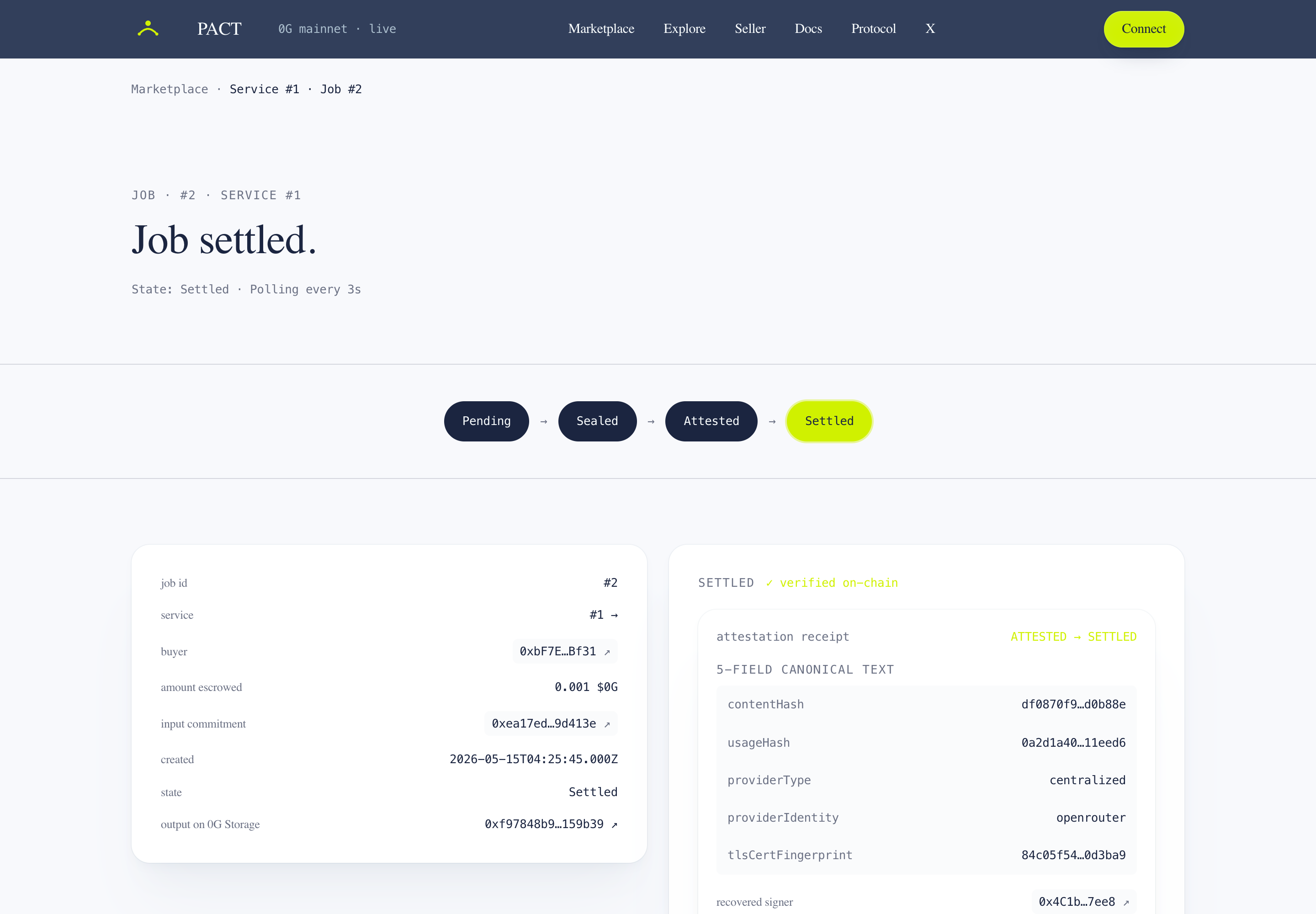
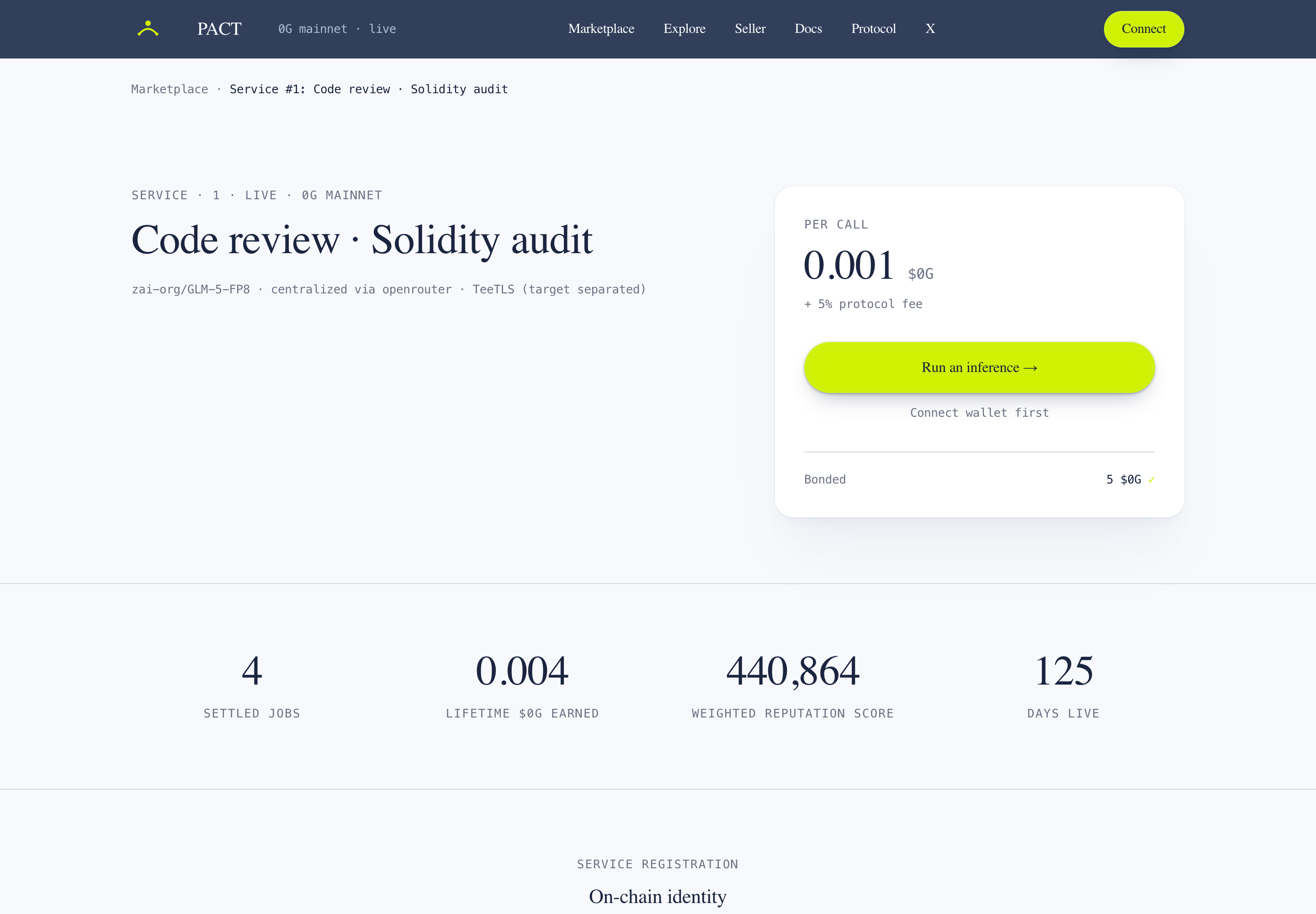
The web product includes a marketplace, seller service surfaces, job details, a verification view and an explorer. Each surface exposes a different part of the same flow: what is offered, what ran and what evidence supports settlement.
The settlement path
Execution and payment meet at verification.
The reference seller watches for a funded job, calls the inference provider and submits its attestation. The escrow contract verifies the signer, records settlement and releases payment in the same transaction. Agent reputation is associated with the agent identity rather than only a seller wallet.
- 01Buyer funds a service job
- 02Registered seller executes inference
- 03Provider supplies attestation
- 04Contract verifies registered signer
- 05Escrow settles payment
- 06Agent reputation updates
Independent inspection
The browser can recover the signer too.
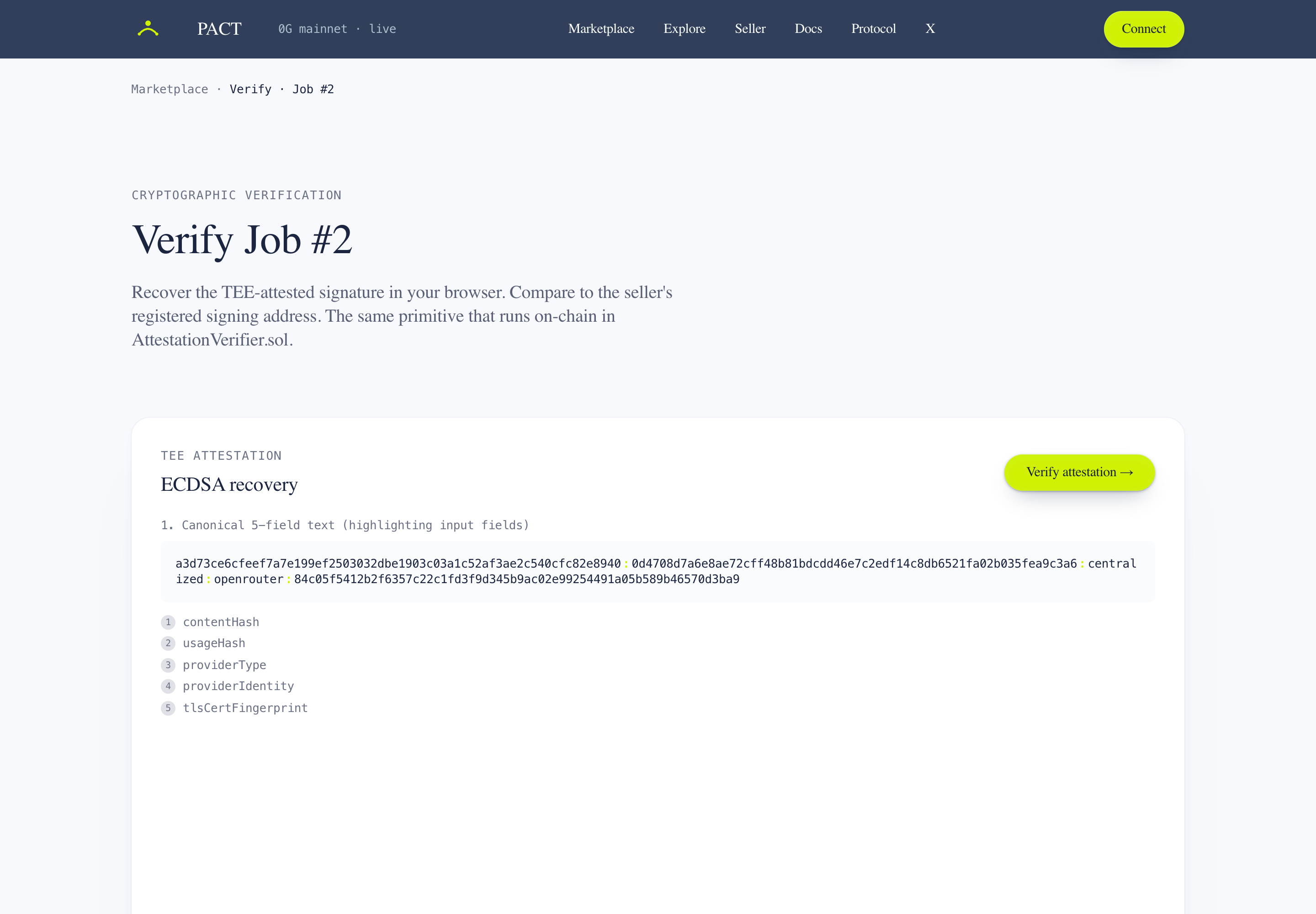
The verification view uses the attestation bytes and ECDSA signature to recover the signing address locally. It compares that result with the registered service identity. This proves the signature relationship; it does not certify the usefulness or factual correctness of an AI answer.
Beyond the interface
One protocol, several ways to use it.
A TypeScript buyer SDK, MCP tools and a public indexer API expose the service and job model beyond the website. The hosted MCP surface provides read tools; transaction-capable local tooling has its own wallet configuration. Documentation explains the same flow for integrators.
The research
A public implementation with a deliberately bounded scope.
The repository includes contracts, a reference seller, the web product, SDK and MCP packages. The public website was paused when this case study was prepared; the captures show the project source rendered against public chain data. The documented release has a single seller in scope. Studio R&D is where we test verifiable AI commerce before it becomes a client requirement.
What shipped
- Escrow and attestation contracts
- Service marketplace and job pages
- Reference seller agent
- In-browser signature verification
- TypeScript buyer SDK
- MCP server
- Indexer API
Evidence
- Public source (opens in a new tab)
- Screens rendered from source against public chain data
- Settled jobs documented in the public repository
What changed
A buyer can check that a paid AI job was signed by the registered provider before payment settles, in the browser or through the SDK.
Next project
SetYourAgency